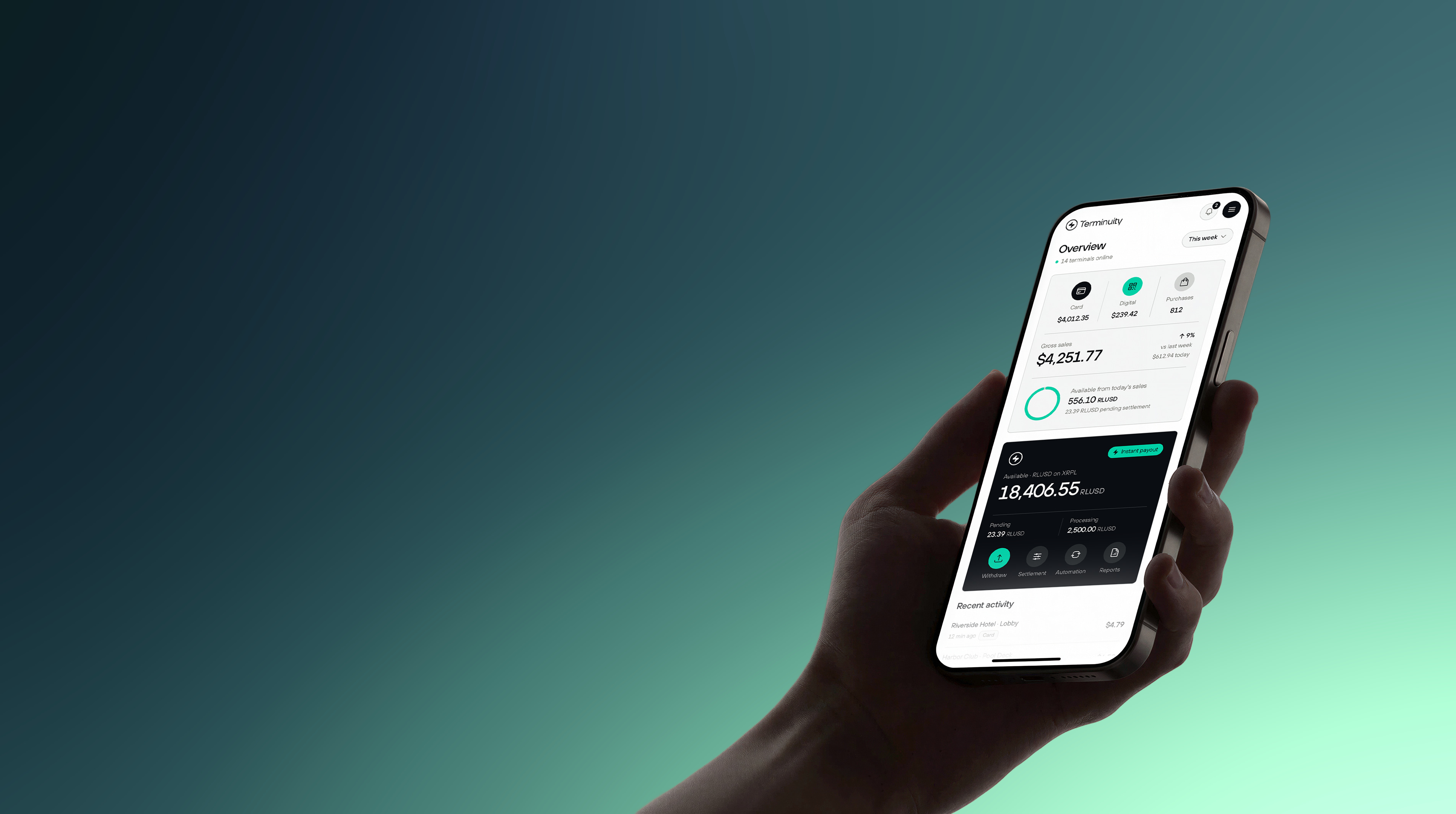
A merchant-side terminal that runs as a decentralized application.
Terminuity does not build payment networks. We do not run vending routes. We build the layer in between, which today does not exist in any usable form in the U.S. market.
The terminal is the dApp. It generates a standards-based payment request, listens to the XRPL via WebSocket, and fires the dispense signal when payment confirms on-chain. The customer pays with whatever wallet they already carry. We never build a consumer-facing app, manage user accounts, or sit in the money transmission chain.
U.S. automated retail hardware is frozen in 1993.
The cabinet, the dispensing mechanism, the operator backend — all are recognizably 1990s infrastructure. Meanwhile payments, consumer expectations, and settlement technology have transformed completely. Nothing today connects the two.
- Payment logic is baked into the MDB controller — the serial protocol from 1993 that still runs the entire industry.
- Adding a new payment method typically means a service call and a $400 retrofit kit per machine.
- Cash is disappearing in the U.S. market. Card-only is about to feel dated. Mobile wallets remain a second-class citizen in vending.
- Ledger-based settlement is moving from pilot to deployment in advanced markets. U.S. machines cannot participate at all.
- The incumbents are card-rails businesses by design. Their entire revenue depends on processing fees that ledger settlement makes obsolete.
One terminal. Three payment options. Zero card readers.
The terminal is the dApp. The customer's phone is the payment instrument. The XRPL is the settlement layer. The machine is the dispense mechanism. Every payment method runs on the same single piece of hardware.
The three payment options on one terminal
The terminal screen presents three options. They coexist on the same hardware. NFC handles Apple Pay and Google Pay. The display generates the QR for ledger payments. No separate components, no card slot, no chip reader.
Why the XRP Ledger
The XRP Ledger was built from 2012 with universal interoperability as a foundational design goal. Two protocol features make "pay in anything, receive in anything" real, both running automatically beneath every transaction.
Production ecosystem on the XRPL
The XRPL is the network most CBDC pilots are being built on. As central banks deploy digital currencies, the wallets issued to consumers will be XRPL-compatible by default. That is the largest forward-looking adoption surface in the entire payment landscape — and it converges with the same architecture this product runs on.
Beyond CBDCs, retail-facing solutions like Frii Pay (point-of-sale software linking traditional terminals to the XRPL) and Xaman (developer SDK and wallet for QR-based payment requests) demonstrate that the merchant-side dApp pattern works in production. What does not yet exist is the unattended-retail and operator-grade hardware layer that wraps these primitives into a real product. That is the gap.
This already works at scale. In Japan.
JR East's acure pass platform proved every component of this thesis between 2017 and 2024. The system did not retreat when the original hardware reached end-of-life — it evolved into a full ledger-backed wallet ecosystem. The U.S. has none of this infrastructure.
Hardware and software evolve in parallel. Machines get redesigned every seven years. Operators who win are the ones building both layers in coordination. The U.S. market has none of this infrastructure yet. That gap is the opportunity.
Four companies. All card-rails. Zero ledger architecture.
The U.S. unattended retail technology market is in active consolidation. None of the consolidators have moved toward ledger-based or network-agnostic settlement. Their business models depend structurally on card processing fees — which means they are structurally incentivized not to build what we are building.
1.28M active devices
Acquired for $848M
The dominant U.S. unattended retail platform. Cashless card readers, telemetry, route management, and a full operator backend. Acquired by 365 Retail Markets in 2025 at $848M, creating the largest unattended retail platform in North America. The consolidation signals both that the market is real and that strategic acquirers are active.
No ledger settlement Card rails only No design ambition1.46M connected devices
$6.4B processed
More technically sophisticated than Cantaloupe and growing faster. 2025 revenue up 27% year over year with 2026 guidance of $510M to $520M. Their Onyx card reader is one of the most widely deployed unattended payment terminals in the world. Recent acquisition of Lynkwell signals active expansion into adjacent unattended payment infrastructure.
Card rails only No digital asset architecture Active acquirerComponent manufacturer
MDB protocol incumbent
The oldest and heaviest incumbent. Physically manufactures the bill validators, coin mechanisms, and cashless payment hardware inside most vending machines operating today. Heritage brands include MEI, NRI, CashCode, and Conlux — they built the MDB protocol standard that still controls the entire industry. A component manufacturer at their core, not a software or settlement company.
Legacy infrastructure Hardware-first No software ambitionAttended retail
Lightning-committed
An adjacent reference point, not a direct competitor. The structural reasons it is unlikely to enter unattended retail with this architecture:
- Square's flywheel is built around attended retail — merchants with someone at a register. Hardware, software, and support are all shaped for that environment.
- Block's strategic bet is Bitcoin and the Lightning Network. That requires merchants to be paid in BTC, which most operators do not want due to volatility and accounting friction.
- Stablecoin settlement on the XRPL solves a problem Block's architecture does not. Different rail, different merchant proposition.
Modern automated retail has been tried. Most attempts failed.
The category has its own graveyard. Reading it carefully shapes how this is built. The pattern is consistent: technical execution was rarely the cause of death. Coordination, capital sequencing, and operational complexity were.
Byte 2018 — wound down
Smart fridge for offices. Vertically integrated hardware, food sourcing, and software. Tried to own every layer simultaneously. Capital efficiency collapsed under the weight of multi-front execution before unit economics matured.
Cafe X 2014 — pivoted
Robotic barista kiosks. Genuine engineering excellence. Real industrial design. Lost on operational complexity at scale, the cost of route servicing, and a hardware footprint that constrained the venues that could host it.
Briggo 2020 — acquired
Coffee Haus robotic coffee. Strong product, strong fundraising, eventually acquired by Costa Coffee. Could not scale unit economics fast enough as a standalone before being absorbed. Hardware-heavy thesis without the software-side moat.
The pattern
None of these companies failed because the technology did not work. They failed because they tried to build everything at once, ran out of capital before unit economics matured, or carried hardware footprints that constrained where they could deploy. The architectural decisions Terminuity makes — staying merchant-side, partnering for cabinets in early phases, sequencing software before hardware — are direct responses to these patterns.
Why won't an incumbent just do this?
They could, eventually, if they decided to. The more relevant question is what we will have built by the time they try. Six moats are realistic for a company at this stage to actually build.
Discipline lives in what we refuse to build.
The clearest companies are the ones that know exactly what they are not. The architecture is small on purpose. The scope stays narrow on purpose. Every "no" below is the reason the "yes" is buildable.
- Not a payments network. Ripple, Stellar, and others already do that work. We design to their specifications.
- Not a vending operator. We sell or license to operators. We do not run routes.
- Not a consumer wallet. Customers pay with whatever they already carry. Identity, custody, and compliance live there.
- Not a crypto company. The architecture supports digital asset rails because that is where settlement is going. The customer experience is simply: scan and pay with what you have.
- Not luxury. Not budget. Accessible, well-considered, designed to belong in good environments.
For the engineers, the operators, and the deeply curious.
The product summary lives above. The full technical specification, transaction flow, and dApp positioning lives below. Each section opens to a fully-designed view.
A decentralized application is any application that uses a blockchain network as its primary backend infrastructure for logic and data storage. By that definition, every Terminuity terminal qualifies. Three characteristics make the classification load-bearing rather than cosmetic.
- Decentralized settlement. The terminal does not route the transaction through Visa, Mastercard, or an acquiring bank. The merchant's terminal and the customer's wallet interact directly with the XRP Ledger.
- Direct cryptographic signing. Transaction logic is not governed by a merchant server. The customer's wallet uses cryptographic keys to sign the payment payload. Terminuity never sees, holds, or processes the customer's funds.
- Immutability and transparency. Once processed by the XRPL's consensus mechanism, the transaction record is unalterable and permanently visible on-chain. The merchant's reconciliation is the ledger itself.
The legal consequence: because the platform never custodies funds and never sits between sender and receiver, Terminuity is structurally outside the U.S. money services business definition. Compliance burden lives with the wallets, the stablecoin issuers, and the customer's bank. The regulatory surface area is hardware certification and merchant terms — not money transmission.
Removing the card reader simplifies the hardware significantly but does not make the terminal a screen. It still needs to be a real piece of operational infrastructure.
The full end-to-end customer experience. The customer never knows which rail processed the transaction. They scan, approve, and the product drops.
Customer selects a product on the terminal
Industrial-grade touchscreen. Customer browses, selects an item. Total displays in the merchant's preferred currency.
Terminal generates a payment request
Standards-based QR code containing the merchant's destination address, the requested asset, and the exact price. Apple Pay and Google Pay tap zones available simultaneously on the same screen.
Customer scans with their wallet
The wallet parses the request, checks the customer's balances, and runs pathfinding to identify the cheapest route from whatever asset they hold to the merchant's requested asset.
Customer approves with biometrics
Face ID or fingerprint. The wallet cryptographically signs the payload and submits directly to the XRPL network. The terminal does not see, hold, or process the customer's funds at any point.
XRPL validates and settles
Decentralized consensus validates the transaction. Pathfinding executes the asset conversion atomically. Settlement completes in 3–5 seconds. The transaction record is immutable and on-chain.
Terminal detects the on-chain event
WebSocket subscription to the merchant's address fires. The terminal confirms receipt of exactly the amount requested in the requested asset. Dispense signal fires to the machine's mechanical system.
Product drops
The customer collects. End-to-end elapsed time: typically under 10 seconds. The customer's experience is identical to any modern QR payment. The architecture beneath it is fundamentally different.
The XRPL has been the most quietly capable settlement network in the payments space since 2012. The protocol features that matter for an unattended retail terminal:
What the merchant gets, end-to-end
A local merchant sets their terminal to receive a regulated USD stablecoin. A customer walks up holding XRP, a Euro stablecoin, tokenized loyalty points, or eventually a CBDC. They scan the QR. The wallet runs pathfinding, converts mid-flight, and settles in the merchant's preferred asset. The customer never has to hold a specific currency to shop. The merchant never has to handle a foreign asset.
The "everybody issuing tokens" problem solves itself. The terminal does not need to support every meme coin or vendor-specific loyalty token. It needs to support major stablecoins, whatever CBDC rails materialize, and Apple/Google Pay on the legacy side. Pathfinding handles the conversion logic on the asset side automatically. The architecture self-limits to assets that actually have liquidity.
No complex smart contracts. The XRPL has native payment protocols. The terminal uses standard API calls via xrpl.js or xrpl-py.
The five-step developer workflow
- Create a permanent XRPL account for the merchant terminal
- Set up a WebSocket subscription listening for the merchant's address
- Terminal fetches optimal conversion path for the transaction
- Display the transaction as a scannable payment QR code
- Customer signs payload — XRPL processes payment and emits WebSocket event
This is buildable engineering. The hardest infrastructure layer was already built by Ripple. The terminal-side complexity is in the hardware interface, the operator backend, and the deployment operations — not in the ledger integration.